1/6/25
“Bill Mason”
I met drummer, Bill Mason, when he showed up at one of my music parties in 1992. He played for several years in the Buffalo Nickel band, along with Marv and Kathy Reitz, Pete Hinz, Bob Rubin, and me.
Bill was born on December 29th, 1918, in Washington DC, where his father worked for the Government Printing Office. Growing up in Washington in the mid-1930s, Bill was constantly exposed to great music, attending shows almost every weekend at the Howard Theatre at 7th & T Streets NW. He heard drummers Chick Webb, Joe Jones (with Count Basie), Sid Catlet (with Don Redman), Kenny Clark (with Teddy Hill’s band), Ben Thigpen, Cosy Cole, Gene Krupa, and Sonny Greer. All the big names in jazz performed in Washington in those days.
While still in high school, Bill began taking courses in printing, determined to follow in his father’s footsteps. He and fellow printing students played on makeshift drums made of anything lying around the print shop during their lunch hours. After hearing him play on the homemade drums, Bill’s printing teacher encouraged him to get a drum set, so Bill asked his parents to buy him a kit for his high school graduation present. They agreed, on the condition that they would select a music teacher for him. He graduated in 1937 and got his drums. His instructor was Bill Kiefer of the U.S. Marine Band.
He practiced four hours every day – one hour on rolls, one hour on reading, one hour on tempos, and an hour on solos. He practiced so much that it worried his mother, who encouraged him to get out and catch a show once in a while. She said he was working like a man who had fifteen kids!
Right after graduation, Bill got a job as an usher at the Lincoln Theatre. While he was working there, he landed his first gig, which was probably arranged by his music teacher. He asked his boss at the Lincoln for a night off to play the gig. When the boss refused, Bill quit his job. That sounds crazy but the gig was with Jelly Roll Morton!
Bill enrolled in Howard University as a music major and began to play in and around Washington with several bands, including Bill Baldwin’s big band. They played weekends at Suburban Gardens from 4 to 11 pm, then at the Lincoln Colonnade from midnight until 4 am. While playing with Baldwin, Bill met Dizzy Gilespie, who was working with Teddy Hill’s band. Dizzy sat in with the Baldwin band late nights during a week’s engagement in Washington. Bill left Baldwin in 1941 when, to avoid being drafted, he enlisted in the army as a musician.
After basic training, Bill was assigned to the 366th infantry regimental band, stationed at Fort Deven, Massachusetts. He attended the Army music school and played with the 366th during his entire time in the service. Their typical day was:
6:15 am - March and play Reveille
7:00 am - Breakfast
8:00 -11:30 am - Rehearsal (mostly classical music)
12:00 noon – Lunch
3:30 – 4:30 pm – Rehearsal (Marches)
5:00 pm - Guard Mount (the band played for marching troops)
At night, Bill and his army bandmates went into town and played with the local bands. On Sundays, they took the train to New York or Boston to sit in with some of the great bands of the day, such as Bud Johnson, J. C. Higgenbotham, Al Hall, and Wilber DeParis. Bill played once at the Metropol with Louis Armstrong when Louis’s drummer lost a family member. Bill played on the WAC Caravan show, circuses, and other shows, including the President’s birthday ball at Boston Gardens. He and his bandmates recorded Bill’s own composition “Drum Mason Drum,” but there’s no evidence of it ever being released.
After his discharge from the service, he played in small clubs in New York with Lester Boone, who led a four-piece combo.
From 1948-1949, Bill attended The Julliard School on the GI bill, studying under Saul Goodman. Bill recalled, “It was like a dream!” Next, Bill got a job with Earl Hines at the Howard Theatre in DC. He moved to Chicago with Hines for a stint at the Regal Theatre. While there, he played on a recording session with Hines.
As the big band era came to a close and work dried up, Bill worked outside of music for many years. He worked as a policeman, a corrections officer, and a fireman.
After his retirement from public service, Bill and his wife moved to Albuquerque New Mexico, where he joined a big band. The bandleader retired and turned the band over to Bill, who renamed it The Bill Mason Orchestra. They played at Kirkland Air Force Base and clubs around Albuquerque until 1975, when both the band and his marriage broke up and he found employment as a truck driver. A 1987 accident cost him is job in New Mexico, so he moved to New York, gaining employment as a truck driver for a family business. After some unusual practices by his employer puzzled him, Bill realized he was working for the mafia. He immediately left New York and moved back to the Washington DC area, getting a job as a school bus driver for a private school.
Bill’s coworker at the school, Dewy Duvall, invited him to my music party at the VFW in Potomac, Maryland. All he brought along with him was a pair of brushes. He told me he could play on a cardboard box or a piece of newspaper. After hearing Bill sound as good as an entire drum kit, while only playing a cardboard box, I asked him to join our Buffalo Nickel Band. Bill played with us for several years until the band went on a hiatus, at which time he joined western swing band, The Oklahoma Twisters, working with them until his health began to decline.
It was an honor and pleasure to know and work with Bill Mason – truly one of a kind.
Photos –
1. Bill Dressed up.
2. Bill with the Buffalo Nickel Band
Tom Mindte
January, 2025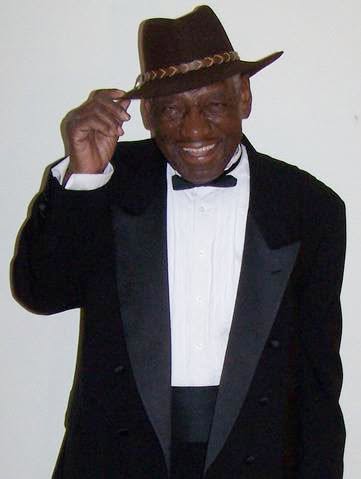
Bill,Dressed up.
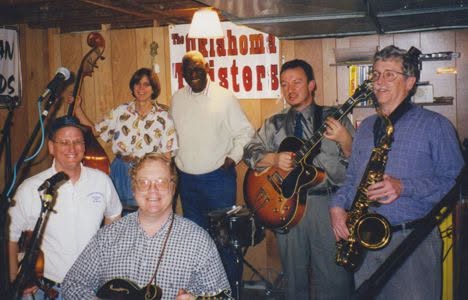
Bill with the Buffalo Nickel Band