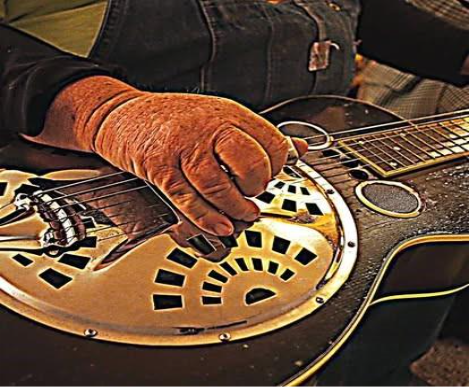
A TRIBUTE DONALD “DONNIE DOBRO”
SCOTT
by Barbara Bamberger Scott
Donald Allan
Scott, known in later life as Donnie Dobro,
was born in Taylorsville, North Carolina, on September 10, 1946,
at home, the third of four children, with a midwife assisting his mother Hazel.
After military service in WWII, Donnie’s father Arnum moved to the Ohio River
area to work on oil rigs, better-paying employment than anything to be
found locally. Hazel and the children moved to Williams, Kentucky, also
on the river.
Donnie grew up in what would now be seen as extreme poverty. Arnum offered little financial support, and
Hazel scratched out what income she could as a seamstress, primarily
working on soldiers’ uniforms. In addition to her sewing skills, Hazel had a
storehouse of acquired infor-mation, probably
from her own humble origins, on plants that could be eaten or
used medicinally. Donnie recalled often going with his mother
scouring the woods for edible plants. The children were given food by
local charitable churchgoers of the Pentecostal Holliness faith, his
mother’s religion. But Donnie went to bed hungry.
Donnie once took me to Williams – a memory trip for him and a
discovery trip for me. One recollection he shared was going to the
Williams public swimming pool (still extant when we visited) – a
large facility with a pool surrounded by a tall metal
fence. Donnie told me how much he and his brother and sisters enjoyed
watching the other children diving and swimming. “But,” I
asked him, “Weren’t you swimming, too?” He replied that there was no way Hazel
could have afforded the perhaps 10-cent admission for each child to
the pool itself, so they watched the fun through the
fence. Back in Taylorsville, Donnie spent much of his youth
living with his paternal grandparents and learning a lot about
farming. His grandfather had apple orchards up in the Brushy Mountains, part of
the Appalachian foothills. Donnie helped with the collection and sale
of apples. He told me that it was not until he was grown up and away from
home that he ever ate a really good apple,
since Grandpa Scott kept the best ones for selling. In later years, Donnie
canned and shared numerous types of apples, all pure and unsweetened,
demonstrating his chemical skills as well as his knowledge of apple varieties
and flavors.
Donnie completed eighth grade in Taylorsville. He recalls that in
school, he and his siblings were considered “trash.” This meant that
though Donnie knew he was smart, he was treated like he was stupid –
though he might raise his hand to answer a question, the teachers would never
call on him, concentrating on those youngsters who had a chance at a
respectable future.
At some
point Donnie and his older brother Gilbert, also a musician, were
taken as passengers with Arnum who had to become a truck driver. Doubtless,
this was an experience that would later serve Donnie well. In his mid-teen
years, Donnie went to Michigan to stay with family there and work in
a factory, work for which he was not suited – tedious, repetitive, and
uncreative. When he returned to North Carolina, at age 17, he and a friend
decided to join the Navy. They enlisted locally and were sent by bus to Raleigh
to await a trip to a Naval base in San Diego, California. In Raleigh they had a
hotel room, money for food, and movie tickets – all very exciting –
but while they were there, President Kennedy was assassinated, America was in
upheaval, and military duty seemed even more crucial.
I am sure
that Donnie was in culture shock when he arrived and settled into the
military and into the hustle and bustle of San Diego, another place we once
visited together. One of his best stories of boot camp was being roused to get
up around 5 am the first morning. One of his fellow recruits loudly complained,
“I can’t get up at 5 am!” The next morning, as that young man lay stubbornly in
his cot when the wake-up was called, soldiers overturned his cot and dumped him
on the cement floor. As Donnie liked to say, “He learned he COULD get
up at 5 am!” Donnie himself states that he was rather
defiant as well, always given the roughest assignments as
discipline. Still, Donnie’s life improved considerably. He had enough to
eat and joined a zestful culture of camaraderie, bar-going and women-pursuing.
Moreover, he was tested and found to have a very high IQ and excellent
grasp of math, chemistry, and engineering, which lead to his assignment in Viet
Nam as a Radarman on patrol boats. His experience of war hit hard: upon first
arriving in Viet Nam, his barracks was attacked by the Viet Kong and several of
his buddies were killed.
Donnie would
later state that “Perhaps those years in the Navy were my most musically
formative years, because I was exposed to a lot of different styles of music. I
learned to like much of the Oriental Music.” (Singing at the Clothesline by Susi
Lawson). Returning to the US after four
years in the Navy, Donnie would marry, adopt a daughter, Shannon, and
father a son, Joseph, known early on as Jody. This first marriage, like many
such, ended in bitter divorce. After he and I became wedded (I could say welded),
Joseph, to whom Donnie had given his first mandolin and who combined that with
a strong, unwavering vocal style, stayed close for some time, making sterling
music. Donnie and I would later share family occasions with Shannon, her
husband John and their two children, Leandra and Caleb, who have grown into
musicians performing with their college bands.
Donnie was a
trucker for ten years, then used military benefits to attain a BA in
Mathematics Education from the University of North Carolina, the first in his
family to complete college. He was also able to pursue his core interest in
music, attending, sometimes with Jody / Joseph in tow, local weekend
conventions and jams and developing his talent with his preferred instrument –
the dobro.
Having given
up on school teaching after one frustrating year, Donnie found work as a
chemical tester in a local asphalt plant and was recruited by a
large paving company as an Estimator. When he started what would be his
longest career stint, he was the company's only employee with a college
degree, his math, engineering chemical and trucking skills all coming into
play, allowing him to rise in responsibility, pay level, and general stature as
the years passed.
________________________
In April
1994, I returned from living overseas (England, Spain, Africa, Latin America)
to settle again in the US and reunite with my three children. I had attained a
bachelor's degree via Quakers for whom I worked in Botswana and had studied and
performed old-time / folk music in London with Peggy Seeger, Ewan McColl, and
Tom Paley. I settled in Black Mountain, NC, where a friend advised me to go to
the long-standing, well attended Fiddler’s Grove Fiddlers Convention on
Memorial Day weekend. There I met Donnie Scott, aka Donnie Dobro.
Our initial
meeting occurred when he offered me a cold potato as I was strolling about – he
had cooked taters at home, iced them and was preparing to heat them when I
crossed by. We joked, perhaps flirted for a short while. Later, again
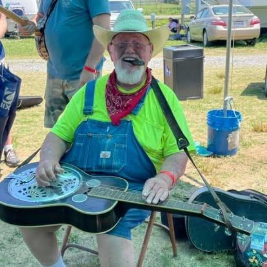
wandering, I encountered him and his band practicing. He played dobro – an
instrument I had only limited knowledge of - and the group sang like real
hillbillies, though not all of them fit that designation as well as Donnie.
That night I joined an informal jam with Donnie and others, singing and
picking. I was enthralled but felt very much out of place – in London I had
been, as an American singer, a big fish – here in the real America, I was
drowning.
The following
day, a friend of Donnie’s informed me that he had told his friends that “I’ve
met the woman I’m a-gonna marry!” And so it turned
out, as so often did Donnie’s declarations bear the fruit he had planted in
them. We were married two years later at Fiddler’s Grove, on the porch of an
old log cabin. But I have always felt convinced that when we met in 1994 we
exchanged our true and permanent vows: as we were saying goodbye on the last
day of the convention, we had a friendly hug and Donnie, knowing he was younger
than me, asked if he could be my “toy-boy” - and I responded that I would enjoy
being “the older woman.” Deal sealed with a friendly kiss. From that moment
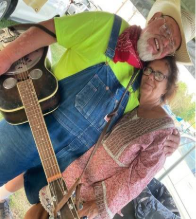
onward, we were a couple - for 30+ years.
Donnie and I
had a strong inner connection, even though he was everything my mother warned
me against: sailor, truck driver and mountain man. But
he was also brilliant, witty, highly musically gifted,
and perhaps the friendliest person I have ever known. I’m sure many would agree
with that. We saw each other on weekends, living apart even for a while after
we were married. He enjoyed driving - the commute from Black Mountain to and
from his home in Taylorsville was about 80 miles each way, and as time would
tell, travel became a major template in our relationship. With his oversight I
was gradually introduced to real folk music – old time, bluegrass, you
name it. I don’t know if he learned anything from me – except that he could be
loved unconditionally – and I learned that from him as well.
As anyone who
knew Donnie would attest, our attachment to music took us to many different
venues, with Galax, Sparta, and Mt. Airy becoming part of our yearly circuit.
But even as importantly, to us, was that during the winter months – December
through March – when the paving business basically shut down, and I worked
mainly parttime in social services, we were free to get in the car and just go.
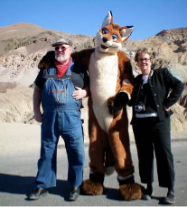
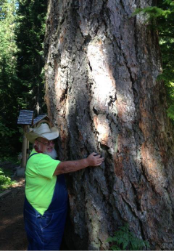
In the ensuing years, we traveled many thousands of miles in all the lower 48,
finding places we enjoyed returning to – mountains, motels, hot springs, Texas
barbecue cafes – you name it. From his trucking years, it seemed Donnie knew
every highway and back road in America. We took full advantage of our travel
opportunities while setting up comfy living quarters in Surry County, NC, first
in Dobson, then Mount Airy – both pleasant, convenient home fronts. We also
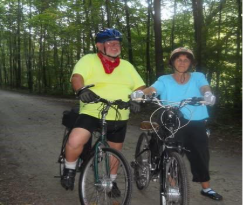
biked often – when I first met Donnie, he spoke proudly of having done a
“century” (100 mile) bike ride. Our forays ranged from 5 to 30 miles in state parks
and local, mountain, coastal, and urban settings.
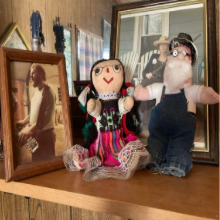
Winning
prizes for his dobro skills at the various fiddlers and music conventions he
attended was only one channel for his talents. Donnie was a writer, utilizing
the rapidly evolving computer modalities. His many zingers, first via email and
then on Facebook, hallmarked his clever wordsmithing and his underlying
political, social, and spiritual viewpoints. His remarks, often recalling
historic events, geographical illuminations and current happenings in the wider
world, were enjoyed and sometimes argued about among his large scope of net
friends. The result, Donnie’s book, Two Lane Traveling, to which I
contributed editing and occasional droll remarks about him (to match his about
me). Two Lane Traveling is still
available on Amazon.
Everyone who
knew Donnie, even for a short time, would doubtless have stories to tell – most
of them likely funny or in some way appreciative. He and his buddy Tom Mindte
helped many young musicians – from age 5 and upwards – to get a start pickin’
and singin’ - and several now are well known in the music scene. Tom was an
invaluable support throughout the years, both as a close friend / bandmate, and
as manager / owner of Patuxent Music, where six of Donnie’s music productions
were recorded and distributed. Donnie and Tom always enjoyed being with young
aspiring musicians, encouraging their musical efforts, often including them in
their competition band, The Ragged Edge. One remarkable connection came via
Facebook: Donnie began communicating with the Brandenburgers, an Amish family
in northern Indiana who wanted to master bluegrass singing and instrumentation.
Donnie was soon “adopted” by them. He imparted his musical wisdom
and we enjoyed their warm hospitality and an opportunity to observe and mix in
their unique, faith-based lifestyle. The family band has become well-known and
can be seen on YouTube.
Bluegrass Unlimited gave Donnie Dobro’s productions positive reviews. The December
2001 issue noted that "Donnie Scott is a maestro of the resonator guitar
... Scott proves to be both an adept musician and serious composer..."
Donnie is one of many well-known local Appalachian musicians cited in author / photographer’s
Susi Lawson’s remarkable book, Singing at the Clothesline. In Lawson’s conversation with Donnie, he
stated that, “My style is my own...I never had any music teachers, so my style
is unique.” Donnie is featured in the Jan-Feb 1995 pamphlet “Country Heritage”
with photos, a review of his cassette On the Edge, and an interview in
which he states that “...if it doesn’t come naturally to me, I can’t play it.”
DONNIE DOBRO’S PASSING
Donnie Dobro
passed away on February 1, 2025, after a very long period of deteriorating
health, with heart, lung and kidney weaknesses. He was courageous to the end,
never wishing to burden others with complaints about his pain, though in his
final year he had many hospital stays that surely caused some worry among his
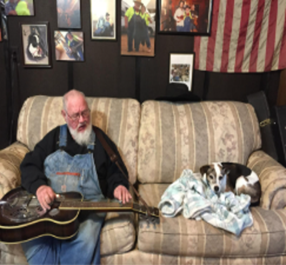
close friends, who often visited him in his magnificent Man Cave - half of a two-car garage made into a
chamber full of instruments, posters and portraits of friends and family, and
plenty of room for Donnie, me, and whatever dog we had at the time, to nestle
in and listen to good ole vintage recordings. Donnie had been rated as 100%
disabled by the Veterans Administration resulting from his Viet Nam War
service. There was no formal funeral, as he had often insisted, “I don’t want
people crying about me.” An appropriate military commemoration was held at the
Veteran’s facility in Salisbury, NC, where his ashes are ensconced in a stone
niche. Soon after, as he had wished, a lively, happy-faced music celebration
was held at the MacArthur Inn in Narrows, VA, a venue we had often visited for
their cozy, friendly Thursday night jams.
All who loved Donnie Dobro and whom he loved will doubtless
long celebrate his time on earth with fond reminiscence.
DONNIE DOBRO RECORDINGS:
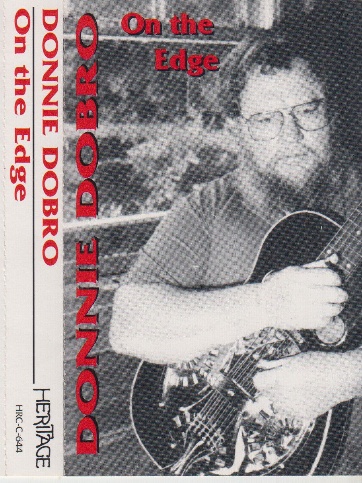
ON THE EDGE: Heritage, 1992.
“Not only did
On the Edge showcase Donnie’s technical mastery of the dobro, but it
also revealed his heartfelt connection to the stories behind the music,
blending traditional sounds with his own poignant experiences and wit. Friends
and fans alike have remarked on the distinctive, almost narrative quality of
his playing, which seemed to capture both the joy and struggle of his life’s
journey.” The cassette, directed
entirely by Donnie, is daring and highly creative, including four tunes that
Donnie composed – On the Edge, Sweet Shay, Tet 68 -
a mournful tune harking back to his service in Viet Nam – and From Murphy to
Manteo, referencing his regard for his home state. Musicians include Steve
Kilby, Bill Williams, Tim Lorsch, Randy Greer, Arnie Soloman, James Ford, Tom
Mindte.
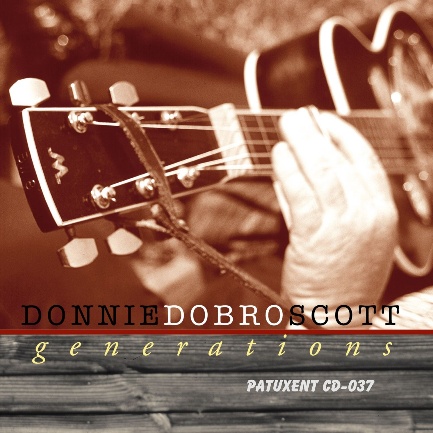 GENERATIONS: Patuxent.
Musicians: Barbara Scott, Joseph Scott, Becky Barlow, Mark
Delaney, Merl Johnson, Steve Kilby, Danial Knicely, Nate Leath, Jim Loyd,
Victoria McMullen, Joe Meadows, Jeff Michael, Lujean Michael, Tom Mindte.
Original songs by Donnie and Barbara Scott: Leaving Tug Valley, Faded Rose,
Yesterday I Didn’t Know, Everyone Has to Answer.
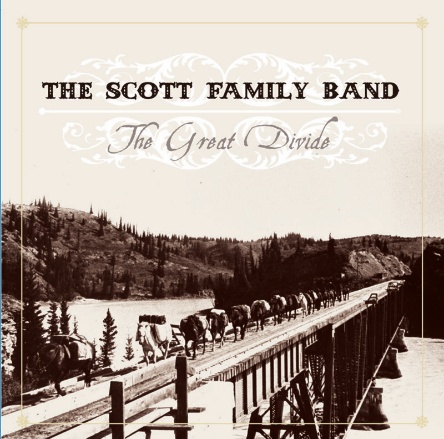 THE GREAT DIVIDE: Patuxent, 2007.
Liner notes by Barbara Bamberger Scott: “Donnie was immersed in
what he likes to call ‘mossy bluegrass,’ the kind of music he grew up hearing
on the radio around Taylorsville and as a long-distance trucker crossing and
recrossing the lower 48.” Scott Family Band: (Donnie on guitar, Barbara on
guitar, fiddle and vocals, Joseph Scott on mandolin and vocals, with Fred Mock
on bass). Original songs by Barbara Scott: The Great Divide, Crossing the Great
Divide.
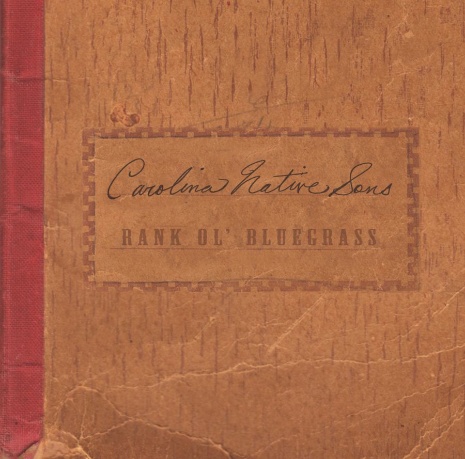 RANK OL’ BLUEGRASS: Patuxent,
2009.
RANK OL’ BLUEGRASS: Patuxent,
2009.
Liner notes by Joseph Scott: “My summers were spent in a rusty
old van, going to and from bluegrass festivals with my dad...his dobro playing
speaks for itself.” Musicians, calling
themselves Carolina Native Sons: Clarence Greene, Joseph Scott, Nate Leath,
Mark Delaney, Neil Knicely. Original songs by Donnie and Barbara Scott: A
Couple a Dozen, Changing Winds Changing Times. This production was created to
honor Clarence, a notable regional music figure with whom Donnie had done music
from an early age and who passed away shortly after its release.
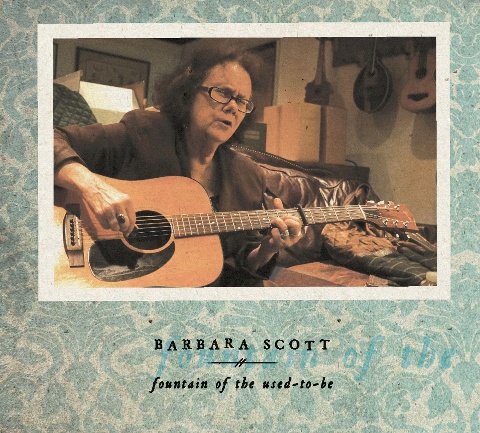 FOUNTAIN OF THE USED-TO-BE:
Patuxent, 2017.
FOUNTAIN OF THE USED-TO-BE:
Patuxent, 2017.
Liner notes by Jim Beaver: “’If you love a song, carry it
along.’ This tenet of Barbara Scott is responsible for this collection of
songs.” Barbara Scott, guitar and lead vocals, Donnie
Scott, guitar, with Elizabeth Baker, Taylor Baker, Merl Johnson, Tom Mindte,
Fred Mock. Original songs by Barbara Scott: Drink to Fair Annie, Fountain of
the Used-to-Be.
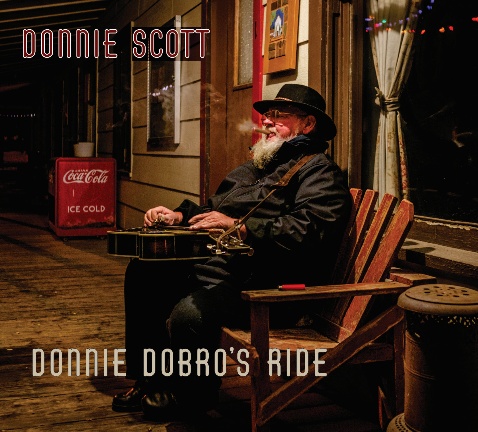
DONNIE DOBRO’S RIDE: PATUXENT, 2018.
Liner notes by Jim Beaver: “’Most of these people I’ve known
since we were children,’ says Donnie.’” Donnie met Tom Mindte in 1979...they
connected over a mutual love of ‘those old morbid graveyard songs.’” With
Brennan Ernst, Nate Leath, Casey Driscoll, Mason Via, Mary Dunlap, Taylor
Baker, Mark Delaney, Fred Mock, Ben Silcox, Elizabeth Baker,
Tom Mindte. Original song by Barbara and Donnie Scott: Romany Rye.
Donnie Dobro compositions: Donnie Dobro’s Ride, D-String Bounce.
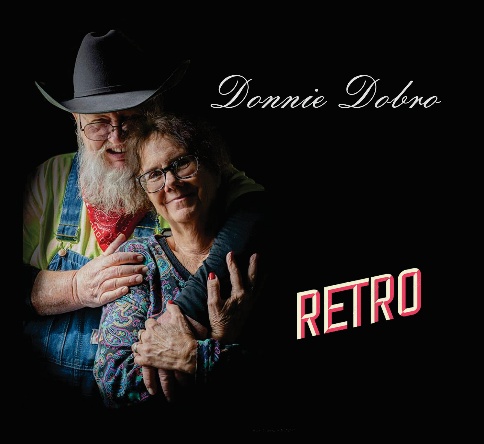 RETRO: Compiled by Patuxent,
2023.
RETRO: Compiled by Patuxent,
2023.
Liner notes by Donald Scott: “These are some recordings that I
have done in the past...I hope you can look past the mistakes and appreciate
what is here.” Collection of pre-recorded numbers from various sources. With Joseph Scott, Barbata Scott, Merl
Johnson, Danny Knicely, Brennan Ernst, Lujean Keepfer, Steve Kilby, Jeff
Michael, John Boulding, Joe Meadows, Becky Barlow, Tom Mindte, Clarence Greene.
Original song by Barbara Scott: Bonnie Brown.